Self Assessment Paper Tax Return Deadline 2026: What to Do Before 31 October
If you plan to submit your Self Assessment tax return on paper, an important deadline is approaching quickly.
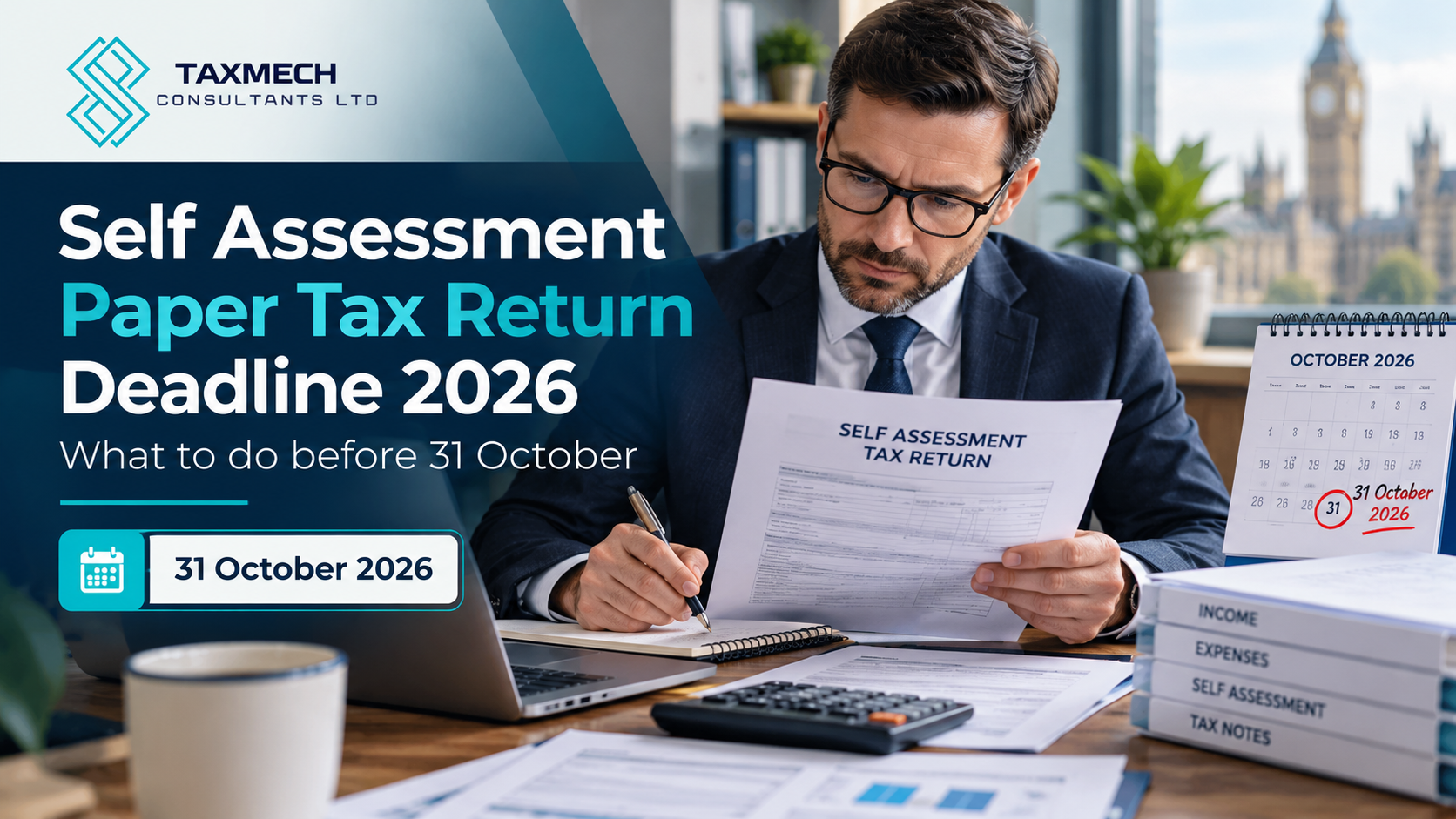
For most taxpayers completing a paper return for the 2025/26 tax year, HMRC must receive the return by 11:59pm on 31 October 2026.
The tax year covered by the return runs from 6 April 2025 to 5 April 2026. GOV.UK
With only a few weeks left, taxpayers still relying on a paper return should check that their records are complete and avoid leaving preparation until the final days.
Who Does the 31 October Deadline Apply To?
The deadline mainly affects people who choose to submit a paper Self Assessment tax return rather than filing online.
Self Assessment may apply to people such as:
- sole traders;
- business partners;
- landlords;
- people with certain untaxed income;
- individuals with taxable foreign income;
- people with certain capital gains; and
- others whose circumstances require a tax return.
HMRC says individuals generally need to complete a return where, for example, they were self-employed as a sole trader and earned more than £1,000 before deductible expenses, were a business partner, or had certain other untaxed income. GOV.UK
What Is the Exact Paper Filing Deadline?
For the 2025/26 tax year, HMRC must normally receive the paper return by:
11:59pm on 31 October 2026.
It is important to understand that this is a receipt deadline.
Posting the return on 31 October does not necessarily mean HMRC will receive it by the deadline.
If you are sending a paper return close to the deadline, you should therefore allow sufficient time for delivery. GOV.UK
What Happens If the Paper Return Is Late?
A late Self Assessment return can result in an initial £100 late-filing penalty.
Further penalties can arise if the return remains outstanding for longer periods.
Current HMRC guidance states that late-filing penalties can include:
- an initial £100 penalty;
- after three months, £10 per day for up to 90 days;
- after six months, a further penalty of 5% of the tax due or £300, whichever is greater; and
- after 12 months, another 5% or £300 charge, whichever is greater.
These filing penalties are separate from penalties or interest relating to late payment of tax. GOV.UK
Can You File Online Instead?
For many taxpayers, yes.
If you have not submitted your paper return and you realise you are unlikely to meet the 31 October deadline, you may still be able to submit the return online.
The normal online filing deadline for the 2025/26 tax year is:
31 January 2027 at 11:59pm.
HMRC's internal guidance confirms that taxpayers who miss the normal paper deadline can generally still file online by 31 January without triggering the automatic late-filing penalty that would apply to a late paper return, provided the online deadline itself is met. GOV.UK
This can make online filing a useful alternative for taxpayers who are running out of time.
Do All Tax Returns Have the Same Paper Deadline?
No.
There are exceptions.
Certain taxpayers who cannot file online for technical or operational reasons can have a later paper filing deadline.
HMRC specifically identifies some situations, including certain pension scheme trustees, non-resident company landlords and non-UK resident partnerships, where different rules can apply. GOV.UK
You should therefore check the rules applicable to your particular return rather than assuming every paper return has exactly the same filing date.
What If HMRC Asked You to File Late in the Year?
The normal 31 October date does not always apply where HMRC issues a notice to file after the usual point in the year.
HMRC's guidance states that a taxpayer should generally receive at least three months to submit a return after the notice is issued.
This means someone who receives a late notice may have a different deadline from the standard 31 October or 31 January dates. GOV.UK
If HMRC has recently asked you to file, check the date shown on your notice carefully.
Do You Have to Pay the Tax by 31 October?
No.
The paper filing deadline and the tax-payment deadline are different.
For the 2025/26 tax year, Self Assessment tax is generally due by:
31 January 2027 at 11:59pm.
The normal online filing deadline is also 31 January 2027. GOV.UK
This means submitting a paper return by 31 October does not mean the tax itself has to be paid in October.
However, preparing the return earlier can give you much more time to understand what you owe and plan for the January payment.
Why File Before the Last Few Days?
Paper filing can involve risks that online filing does not.
Possible issues include:
- postal delays;
- missing pages;
- unsigned declarations;
- incomplete supplementary pages;
- calculation mistakes; and
- discovering missing records too late.
Filing earlier gives you time to correct these problems.
It can also help reduce the pressure of trying to reconstruct an entire year's income and expenses immediately before the deadline.
Records Sole Traders Should Check
Sole traders preparing their 2025/26 return should make sure their bookkeeping is complete.
That may include reviewing:
- sales and invoices;
- cash income;
- business bank transactions;
- purchases;
- allowable business expenses;
- mileage and travel;
- professional fees;
- equipment purchases; and
- other relevant business records.
Incomplete bookkeeping can lead to incorrect profit figures and, consequently, an incorrect tax calculation.
Records Landlords Should Check
Landlords should make sure their property records are complete before submitting their return.
Typical records may include:
- rent received;
- letting-agent statements;
- repairs and maintenance;
- insurance costs;
- professional fees;
- service charges;
- property-related expenses; and
- finance-related information where relevant.
If you own more than one property, it is especially useful to reconcile rental income against bank statements before completing the tax return.
Should You Estimate Missing Figures?
Tax returns should be based on accurate records wherever possible.
If information is genuinely unavailable, particular rules may apply to estimated or provisional figures.
However, guessing simply because records have not been organised is not a good approach.
Where possible, taxpayers should first obtain missing bank statements, invoices, rental statements or other evidence.
If you are unsure how incomplete information should be treated, professional advice may help avoid an incorrect return.
What If You Already Know You Cannot Meet 31 October?
Do not simply ignore the deadline.
If you are eligible to file online, consider switching to online filing and working towards the 31 January 2027 deadline instead.
If your circumstances prevent online filing or you believe a special deadline applies, check the relevant HMRC rules.
Submitting a paper return after its applicable filing deadline can result in the £100 initial penalty even where little or no tax is ultimately due. GOV.UK
What About Late Payment?
Filing the tax return and paying the tax are two separate obligations.
Even if your return is submitted on time, paying tax late can lead to additional penalties and interest.
HMRC states that Self Assessment tax for 2025/26 generally needs to be paid by 31 January 2027. GOV.UK
It is therefore useful to calculate the expected liability as early as possible rather than waiting until January to discover the amount due.
A Practical October Checklist
If you intend to file a paper return, check the following now:
- Confirm that Self Assessment is required.
- Make sure you are using the correct 2025/26 return.
- Gather all income information.
- Reconcile your business or rental records.
- Check allowable expenses.
- Complete any required supplementary pages.
- Review your tax calculation.
- Sign the return where required.
- Make a copy for your records.
- Send it early enough to reach HMRC by 31 October 2026.
If paper filing is becoming impractical, check whether online filing is available to you instead.
Paper or Online: Which Is Better?
For many taxpayers, online filing offers practical advantages.
It provides a later deadline, performs many calculations automatically and avoids postal-delivery risk.
The deadlines for 2025/26 are generally:
| Filing method | Deadline |
|---|---|
| Paper tax return | 31 October 2026 |
| Online tax return | 31 January 2027 |
| Tax payment | 31 January 2027 |
This does not mean everyone should wait until January.
Submitting earlier gives you more time to understand the tax bill and deal with any problems.
How TaxMech Can Help
Preparing a Self Assessment return can become difficult when bookkeeping is incomplete, there are multiple income sources, or business and personal transactions have become mixed together.
TaxMech Consultants Ltd can help taxpayers organise their records, review their income and expenses and prepare their Self Assessment accurately.
If you are planning to submit a paper tax return and have not yet completed it, the 31 October 2026 deadline is now close.
Reviewing your records now can help avoid last-minute errors, missed information and unnecessary penalties.
Need help with Self Assessment?
Our Self Assessment service provides practical, professional support tailored to your circumstances.
Learn about our Self Assessment serviceNeed help with Bookkeeping?
Our Bookkeeping service provides practical, professional support tailored to your circumstances.
Learn about our Bookkeeping serviceNeed help with your tax or accounts?
Speak with TaxMech Consultants Ltd for straightforward, professional guidance.